Orange Pants
Grief, and growth, and my ever-changing ass.

I can still feel the shock of the cold linoleum floor against my exposed lower back as I reclined at the completion of one sit-up, and then another, and then another. If I concentrate, I can even hear the vaguely wet, uniquely “gelatinous” sound made by warm, bare skin peeling away repeatedly from the floor of the cafetorium (IYKYK) I was in, which was always frigid in a way that surely defied the laws of science.
I was locked in a pre-dance-rehearsal warm-up on an evening which was to be spent preparing for that summer’s community theater project. (As a lifelong performer, I could never stay away from singing for long - I took on at least two such projects during every college break, when the numerous scholastic choirs I sang with went on break.) My pace never waned – as I neared 50 sit-ups, I took note of two show staffers who watched me and whispered all the while. I remember boldly looking one of them in the eye and urging them to make their jokes aloud. And, I remember their response: Actually, they were just impressed.
Admittedly, I was still getting used to the idea of my body – the sight of it, its movements, any of its details, really – being the subject of others’ positive attention.
That day, I also happened to be wearing a garment that retroactively became a talisman of what would be my three-year period of socially approved smallness: The orange pants.
These weren't high-quality pants. Purchased on a student grocery clerk’s salary, they were quite cheaply made - they felt like a parachute, but one that absolutely no one with sense would not trust when the moment came to plummet from a plane’s cruising altitude. They were a muted shade of orange, with navy blue accents near some of their superfluous pockets. (Needless storage for anyone not engaging in fishing or gardening, but it was the early 2000s – kindly extend me some grace.) They were form-fitting flares, but somehow short enough that they didn’t scrape or scuff along the ground, the way most every pair of pants did (does) due to my being so damn short. They rested just above my hips, a merciful one or two inches higher than the widely popular low-rise pants of that era. (Did I mention this was the early 2000s?)
I know they sound ridiculous. They were ridiculous. But I pulled them off – damn well, I might add – and it made me feel powerfully sexy.
And that’s what had hooked me from the first time I’d worn them as a high school senior. I feel quite comfortable broadly calling what I experienced in those years an “addiction.” After a lifetime, to that point, of pudgy awkwardness and extreme discomfort in my own skin, hiding behind black clothing (“It’s slimming!”) and overly large shirts designed to conceal the dough-iest parts of my body, which some referred to – no joke – as “sins” (only because they were taught to do so), I absolutely craved and needed the attention my then-much-smaller frame earned me. Those pants represented the validation, the affirmation, that came with losing weight. And, to the singular thrill of being desired, lusted after, hungered for – not just by those whose want of me was tinged with visible, tangible shame.
I certainly knew a thing or two about hunger, anyway, as self-starvation occupied a foundational tier in my no-food pyramid. Also playing key roles in the maintenance of this slimmer figure were prescribed appetite suppressants that made me feel, to put it plainly, like a fully unhinged person. Forever restless yet simultaneously exhausted from sleep deprivation; heart pounding blood hard throughout my underfed body. (When asked about such side effects by my responsible doctor and genuinely caring and wonderful mother, I lied what was left of my ass off.) There was also an exercise fixation in the mix, which saw me building workouts – plural – into nearly every day of my life. At the top of this fucked-up hierarchy of anti-needs sat iced coffee, salt-free Saltines (they’re a thing) and sugar-free Jell-o (usually red, for no real reason).
I was a jittery, still-insecure mess, but the feel of men’s eyes along my body made it all feel worthwhile – made me feel worthwhile, and alive in ways I’d only previously experienced through that familiar thrill of singing and harmonizing with others.
That creative trait, still one of my most defining, was poured directly into me not by society, as those other messages were, but by my family. It’s in my lineage, my blood, my soul, my heart. Even the swirling of my mind and the ache in my stomach couldn’t take that away.
My grandmother, a figurehead of our family, would have swum in those orange pants.
She was short like me, but slight. Delicate, even. As a child I remember feeling, at times, as though I’d break her if I hugged her too tight.
Everything else about her, though, was gigantic. Obvious. Impossible to ignore. Every thought, opinion and interjection was delivered in what could best be described as a raspy, low bellow, her voice weathered by the fact that she smoked the way most people breathe. The decades-long marriage she shared with my devoted grandfather was as full of love as it was full of contention – we still laugh about some of the more acerbic bon mots they tossed at one another, usually over a marinara that wasn’t seasoned to her liking. My family and I spent most of our Sundays at their Linden, New Jersey apartment, a modest ground-floor space where the two of them hosted us for dinners, Easters and Christmases following her weekly ass-kicking of the Sunday New York Times crossword puzzle – I still see her chicken scratch filling every box when I smell certain brands of cigarettes.
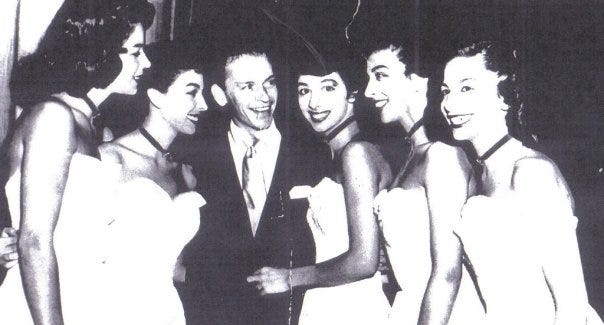
My grandmother’s singing voice was low, too, but that had always been the case. She was one of five in a sister singing group – The DeMarco Sisters – who graced Ed Sullivan and Kate Smith with their harmonies numerous times and shared stages with the likes of Frank Sinatra and Robert Preston (among other impressive credits). My grandmother was always an alto, holding down those intricate bass lines with equal parts precision and warmth.
The slightly yellowed walls of her later-in-life abode held weekly sing-alongs, too, once the fighting died down. Being young – and as such, not yet having a sense of the preciousness and impermanence of life – my participation in these moments skewed reluctant at best, despite having the same finely tuned ear and clear singing voice everyone else in the family was blessed with. My discomfort with my larger body manifested into discomfort around doing anything that brought attention to me once I entered my teenage years – and when I sang, people did notice, even then.
I much preferred to sit back and listen to them blend on jazz harmonies that they could effortlessly recall from performances of decades past, when they were executed under impossibly bright lights while wearing matching, modest dresses and skirt sets.
And… she was gorgeous, in every way a person can be. All of the DeMarco Sisters were. My grandmother had a smile bright enough to light up every stage she set her small feet upon, and a personality that reached to the nosebleeds (and that, in her senior years, charmed everyone in the bingo halls she loved to frequent).
All of the women in my family were and are like this - my mother, my cousins, my nieces, the whole DeMarco-bonded lot. Stunning creatures with captivating, larger-than-life personalities with hearts to match. Creatively gifted beyond belief. Whip-smart and hilarious. Strong and bold as hell. And when it comes to men, the older women of my family have fascinated them for as long as I can remember. (Yes, there are stories.)
To be more specific, they fascinated men in ways I didn’t. Though we of the DeMarco lineage all share a deep love of, and true talent for, singing and blending in ensemble settings, I differ from them in other, rather significant ways. I’m the softest of the lot, in all senses. Rounder, yes. More sensitive, for sure. I genuinely prize this about myself – but I can also see how it’s made me far more vulnerable to piercing.
But the three years when those orange pants were getting triple-platinum levels of rotation… I felt the near invincibility that they must have been accustomed to. The attention, especially from men - whose opinions I could already tell carried more weight than most anyone else’s in our society - changed me. Nevermind the troubling relationships I was cultivating with food, exercise, pills, my body, external validation – I was wanted. And that made me feel fucking unstoppable.
Then … everything unraveled.
Anne DeMarco – “Anna,” as I knew her – died July 27, 2004, roughly one year after the aforementioned sit-up extravaganza. The last time I saw her alive was two days prior – it was my mother’s birthday, which she spent cradled in the arms of one of my older brothers, trying to grapple with the agonizingly slow loss of her own mom, which had begun several months prior to that awful day.
To numb the pain of Anna's decline and ultimate death, I had found solace in the then-forgotten comfort of food – it was almost as if the cells of my former self had remained floating around me, cloud-like, until I occupied them once more with snacks. I turned to that which had soothed me and filled me in my earlier years, before I’d begun leaning into hunger as “the way.”
I gained a significant amount of weight, of course. But I barely even noticed initially – this was my first experience with real and close grief, and everything about it felt goddamn awful. It had made sense to me that my body would, too. It was the worst iteration of living in the present – aching for her presence and sharpness, and caring only about the immediate comfort to be found in, say, fat sandwiches. (To the uninitiated, fat sandwiches are a delicacy originating from Rutgers University, perfect monstrosities that held everything from french fries and mozzarella sticks to chicken fingers and honey mustard dressing between two halves of a sub roll. Everything about them is awful, and even now, I want one.)
One particularly low day, when all I could think about was my desire to simply feel good again, I turned instead to the orange pants, for the first time in ages. After a not-so-delicate dance, they made their way back onto my body – but it just wasn’t the same. One too many fat sandwiches had changed me into someone who could no longer don them comfortably. I knew they weren’t going to work – as attire, or as a panacea – but I tried to make it happen anyway. A bald attempt at seeking solace by reclaiming my burgeoning sensuality.
They busted open midway through the outing I’d worn them to.
Look, at the end of the day, they were just pants – not particularly well-made pants, at that. They were not designed to last. Nor were they made to adjust to the way I’d expanded. And they were certainly not equipped to hold a young woman’s first potent experience with loss. In fact, they were irreparably damaged by the effort. And so was I – or rather, I already was, but in that moment I was forced to face my brokenness as I took in the sight one smooth, thick thigh yearning to break further free from its deep-tangerine prison.
Because my grandmother – a never-wavering, always-vocal staple of my earliest days, my antsy youth, my moody, formative teens and my matriculating years, during which she and other family members oft lamented my decision to switch majors from voice performance to journalism – would never see me sing again. Or see me graduate from college. Or see me land my first job at a local newspaper before I eventually worked my way to CBS News. Or see me land legitimate movie work, or see my name scroll by in the credits in a theater. Or the hundred-million other milestones that have made up my life since she passed away.
… I’d never hear her sing again, either. Or laugh. Or see those finished, discarded crosswords. I'd never give her one of those hugs where I struggled to balance my grasp between lovingly firm and appropriately gentle. All of it - all of her - was lost.
The deaths I’d experienced prior to her passing were either softened by youthful misunderstanding of the gravity of the situation, or had come in the form of far less profound goodbyes – to shitty boyfriends who had needed to go, for example.
Losing someone who was a part of my blood, my foundation, and countless core memories… it rocked me in ways I’d never felt before. It was almost surreal – until the funeral, that is. In fact, I recall how odd it’d felt, before the day we laid her to rest, to tell people about her death, because it felt downright fictitious. Something in me was even concerned that I was somehow accidentally lying about what I was experiencing. That I would be exposed as someone who fabricated the death of her grandmother to curry sympathy. Maybe I was just hoping for that to be the case – that I’d be a phony, but one whose grandmother was alive and well.
But it was real. It reshaped me, in every way (as grief is wont to do). And everything fit and felt “wrong” for a long time afterwards.
Years later, I sometimes still yearn for those stupid pants.
Despite my subsequent, intention-filled evolution toward true self-acceptance and self-love – even as I’m typing this right now, in shorts several sizes larger than the orange pants came in – some part of me still wants what they represented.
But sometimes – things are gone. For good.
Mostly though, I just feel for every iteration of me that ever wore the damn things. The more slender me, who was swept up in harmful habits and toxic messages, and the me who felt as if everything were slipping through her fingers when the pants were ripped apart at the seams - in ways I’d already done myself, internally, but hadn’t yet confronted.
Especially now that I’m a mother, tasked with thinking anew about how this world shapes young minds, I find myself wishing I could gather these two Candices with me somehow, and have us join hands and lock eyes - so they could feel and see my sincerity when I tell them, first, that the younger’s anxiety, and the elder’s grief, would become far more familiar to us in the decades that yawned between us. They’d have wanted the heads up.
I wish I could tell them that, despite the pain that lay ahead for them, we’ll wind up growing and expanding in great ways, ways we could not have imagined until they came to pass, all with the love and support of our remaining family, both blood and found. We’d end up building a beautiful life as a cool-ass Brooklyn mom and partner who writes about women’s work and sings deeply awesome shit with deeply awesome people.
I wish I could tell them that we come to accept, and then embrace, the fact that we Take Up Space. I wish we could tell them that we become BIG, that we at last start to inhabit the boldness of Anna, of our mother, of the Wonder Women we’re related to. I wish I could tell them that there will be a series of men who will try to make us feel badly about this, and who would use that as a means of controlling us, a means of keeping us trapped with them despite behaving as though we were the last thing they wanted – to prepare them for the experience of how stifling male mediocrity is.
I wish I could tell them how we’ll increasingly find it within ourselves push back at them – back, and OUT. Out of those awful situations, and “out” to take up additional inches and decibels of world-space.
I wish I could tell them that they will be desired at all shapes and weights. That there will be those who delight in our curves and softness, who thrill at touching us at even our heaviest, and who feel no qualms about having us visibly by their sides and in their arms and against their lips.
I wish I could tell them that we discover that our body, at any and every size, can finish triathlons and half marathons, once we finally began reveling in the joy of movement for its own sake, and finding fun in food. That it hasn’t known a diet pill in years, almost decades. That it can sing and perform in ways that make people feel better and warmer inside, once we finally allowed ourselves to open our eyes and connect. That it will explore cities and forests alike on foot, and we will feel energized and alive the whole time. That it’s capable of creating a beautiful life, of weathering the devastating, body-splitting surgery required to deliver him into the world – and of caring for the preciousness that emerged while recovering from being broken almost in two.
I wish I could tell them that, best of all, we learn that what we can do, how we look, and how we are perceived will all take a backseat to the revelation that our body’s best trait is its ability to house our heart and wisdom and spirit. That the abilities to "go" and "birth" and "move" and anything else are not requisites for wholeness. That we are a miracle of strength and resilience and love beyond any of it, in how we push past grief and everything else that has knocked us flat, over and over again, to find our footing and ourselves once more. That we are strong in ways even I, the oldest of us, still don’t fully comprehend – but that I very much appreciate.
I wish I could let them how fucking good the revelation will feel.
And if all else fails to ease their ever-worried hearts, I wish I could tell them that we will one day see some of Anna in ourselves – and that we know she’d be so proud of us, no matter what we’re wearing.